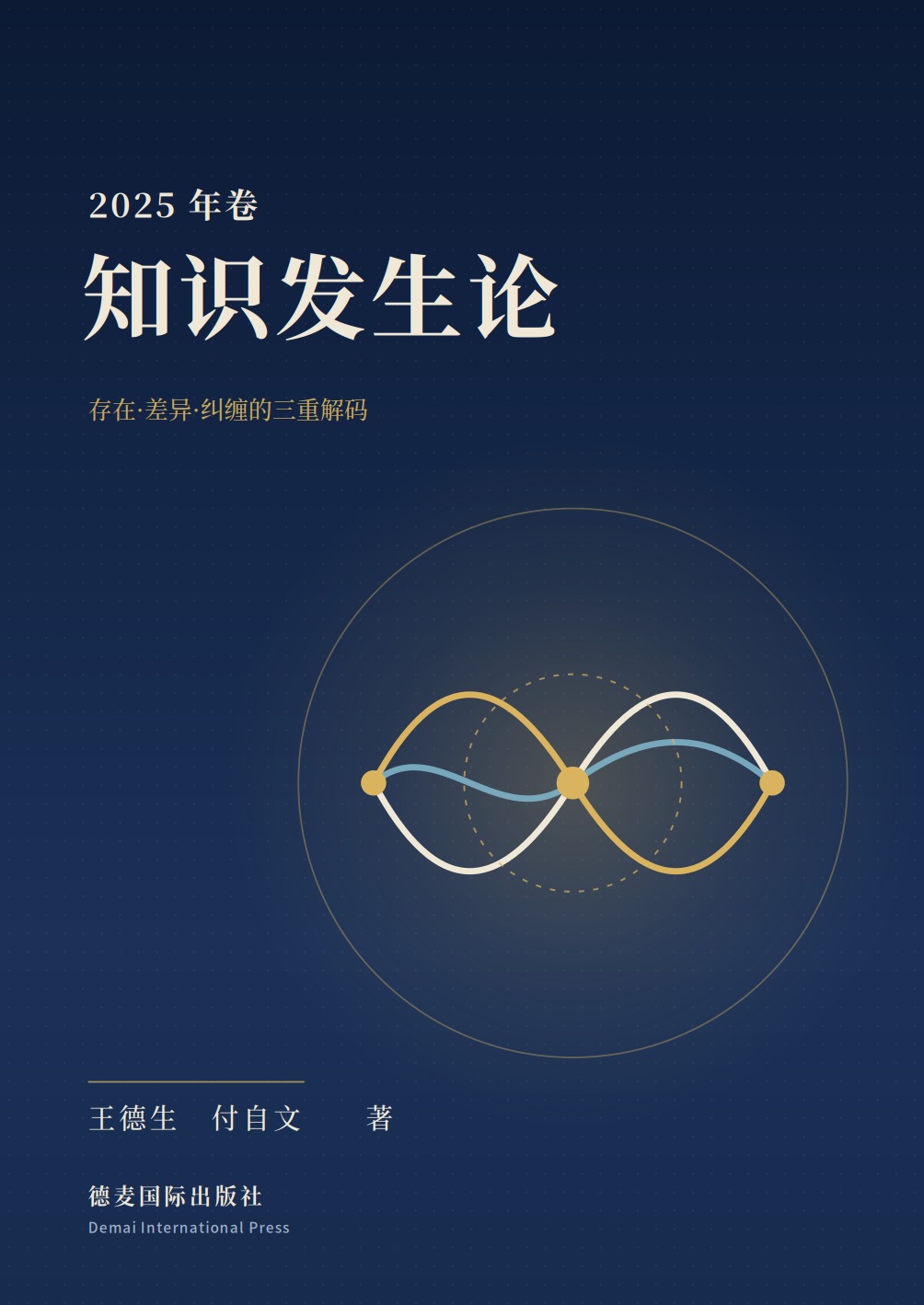
生成认识论 封面
治理与社科 · 德麦国际专著

生成认识论

Generative Epistemology
The Generative Logic of Existence, Difference, and Feature Entanglement
知识不是对预存对象的发现,而是在E中经D成S的发生过程——认识论的根本转向。
内 容 简 介

本书对「知识是什么、又如何诞生」作一次根基性的重思。针对「知识是早已在那里、有待被发现之物」这一主流假设,本书主张:知识是「发生」之事——它经由主体—互动—客体(SIO)的活的构型被生成。主体、互动、客体不是分立的实体,而是一个整体之内不可分割的侧重;当一个 SIO 整体被建模、稳定并变得可共享,散乱的经验就被转成结构,知识由此涌现。

展 开 · 这本书在讲什么

本书随后引入「差异(ΔSIO)」作为知识生长的引擎:任何稳定的理解都含有张力——异常、错配、无法被现有框架同化的模式。ΔSIO 命名的正是这个生成性的增量——那股迫使整体重构的压力。知识以螺旋而非直线推进:一个整体稳定下来,差异累积,一次突破重组结构,一个更新的整体又成为进一步生成的基础。这一动力学解释了为什么真正的创新不是可选项而是必然,也解释了科学与文化革命为何反复发生。

最后,本书解释知识如何经由「特征纠缠」获得力量:当特征结成持久的网络,知识就变得可传递、可操作、可扩展。作者把这建模为知识的「三重 DNA」:符号,使可见与可沟通;逻辑,使可操作与可验证;数学,使可结构化与可推广。三个维度合起来,阐明知识如何转成科学、技术、制度与文明,以及 AI 时代为何同时放大了知识生成的速度与赌注。作为一部系统性专著,本书把哲学、语言、逻辑、数学与技术转型连成一个融贯框架,为学者与创新者提供一套严格的词汇,用以诊断知识危机、设计新的概念结构、并在「知识不再只是被累积、而是被持续生产」的时代培育生成式思维。它是全体系认识论的总闸门。

出 版 信 息 · PUBLICATION
作者 AuthorWang, Desheng; Fu, Ziwen
出版方德麦国际有限公司 · Demai International Pte. Ltd.
ISBN978-1-970820-18-8(Bowker authorId 26927366)
检索Bowker / Bookwire · 可按 ISBN 9781970820188 查询
内 容 简 介 · BOOK DESCRIPTION

Generative Epistemology offers a foundational rethinking of what knowledge is and how it comes into being. Against the dominant assumption that knowledge is something already "out there" to be discovered, this book argues that knowledge is something that happens: it is generated through living configurations of Subject-Interaction-Object (SIO). Subject, interaction, and object are not separate substances; they are inseparable emphases within an integrated whole. Knowledge emerges when an SIO whole is modeled, stabilized, and made shareable-turning scattered experience into structure.

The book then introduces difference (¿SIO) as the engine of knowledge growth. Every stable understanding contains tensions: anomalies, mismatches, and unassimilated patterns that cannot be resolved within existing frameworks. ¿SIO names this generative increment-the pressure that forces a reconstruction of the whole. Knowledge advances through a spiral rather than a straight line: a whole stabilizes, difference accumulates, a breakthrough reorganizes the structure, and a renewed whole becomes the basis for further generation.

This dynamic explains why genuine innovation is not optional but inevitable, and why scientific and cultural revolutions recur. Finally, the book explains how knowledge gains power through feature entanglement. Knowledge becomes transmissible, operable, and scalable when features bind into durable networks. The book models this as a "triple DNA" of knowledge: symbol, which enables visibility and communication; logic, which enables operation and verification; and mathematics, which enables structuralization and generalization.

Together, these dimensions clarify how knowledge turns into sciences, technologies, institutions, and civilizations-and why the AI era intensifies both the speed and the stakes of knowledge generation. Written as a systematic monograph, Generative Epistemology connects philosophy, language, logic, mathematics, and technological transformation into one coherent framework. It offers scholars and innovators a rigorous vocabulary for diagnosing knowledge crises, designing new conceptual structures, and cultivating generative thinking in an age when knowledge is no longer merely accumulated, but continuously produced.