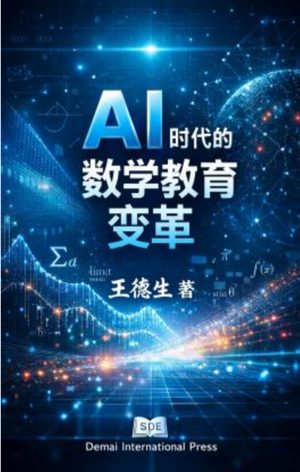
本书对「数学教育在被人工智能重塑的时代必须成为什么」作一次系统的重思。当大语言模型与智能系统在计算、符号操作、模式识别与标准解题上超过人类,数学教育的传统地基——程序熟练、速度、正确率——正迅速失去其教育正当性。本书主张:数学教育已抵达一个结构性坍塌的临界点,唯有一次深层的范式转移,才能恢复它的意义与未来的相关性。
本书不把 AI 框定为威胁或辅助教学工具,而把它看作一个逼迫教育演化的文明转折点。它的核心主张清晰:数学教育的使命不再是「执行」的训练,而是「结构创造、路径治理、意义生成」的培育。当机器主宰了常规推理,人类独有的能力便剩下——定义问题、建构概念框架、驾驭不确定、并把知识转化为活的意义。
扎根于哲学、复杂性科学与作者原创的 SDE 框架(显露·差异·纠缠),本书在五个核心维度上重构数学教育:教育目标、学习路径、动机系统、评价模型、制度设计。它提出一次决定性的挪移——从以分数为中心的考核,转向以意义为中心的评价,用三条更高的标准(创造、自由、幸福)取代狭窄的「正确」观念。数学学习被重新定义为一个生成过程:学习者主动建构概念场、探索由差异驱动的学习轨迹、并在持续的智性投入中养出内在动机。本书给出既具体又哲学上严谨的创新——面向结构的课堂、人机共创的学习模型、证据链评估、作品集评价系统;教师被重新想象为「认知环境的设计者与学习涌现的导演」,学生则不再是既有知识的被动接受者,而是数学世界的主动创造者。这不是一本渐进改革的手册,而是一份教育重生的宣言。
本书全文尚未上线。下面三篇选自王德生 2025 年前后的专著原稿《科技创新内核解码:微积分、特征纠缠和逻辑的SIO重生》、《特征纠缠探秘:知识·技术·艺术的典范转移》、《三律方法学:创造力发生机制解码》,可以先读。
壹科技的数学内核:微积分(下)约 9,300 字在前几章里,我们已经看到了微积分的发展与扩张:从牛顿和莱布尼茨的经典力学出发,逐步进入偏微分方程的连续场科学,再到数值微积分、随机微积分、分数阶微积分以及泛函微积分。 贰形式逻辑三大推理的特征纠缠重生约 2.5 万字 · 原载「SIO教育学」2025-09-10逻辑,是人类理性最早的结晶,却也是现代科学方法论中最饱受争议的基石。自亚里士多德以来,演绎、归纳、类比被奉为逻辑的三大支柱:演绎代表必然性,归纳代表普遍性,类比代表相似性。 叁科学想象三原理约 2.0 万字 · 2025-08-16科学想象,是科学创造链条中最初且最关键的环节。它不是对未来的随意猜测,而是在自我世界 SIO 中孕育一个尚未被认识、尚未具象化的整体(SIO)的新价值之母。The Transformation of Mathematics Education in the Age of AI is a systematic rethinking of what mathematics education must become in an era shaped by artificial intelligence. As large language models and intelligent systems outperform humans in calculation, symbolic manipulation, pattern recognition, and standard problem-solving, the traditional foundations of mathematics education-procedural mastery, speed, and correctness-are rapidly losing their educational legitimacy. This book argues that mathematics education has reached a point of structural collapse, and that only a deep paradigm shift can restore its meaning and future relevance. Rather than framing AI as a threat or a supplementary teaching tool, this book treats AI as a civilizational turning point that forces education to evolve.
Its central claim is clear: the mission of mathematics education is no longer the training of execution, but the cultivation of structure creation, path governance, and meaning generation. When machines dominate routine reasoning, what remains uniquely human is the ability to define problems, construct conceptual frameworks, navigate uncertainty, and transform knowledge into lived meaning. Grounded in philosophy, complexity science, and the author\'s original SDE framework (Show-Difference-Entanglement), the book reconstructs mathematics education across five core dimensions: educational goals, learning pathways, motivational systems, evaluation models, and institutional design. It proposes a decisive shift from score-centered assessment to meaning-centered evaluation, replacing narrow notions of correctness with three higher criteria: creation, freedom, and happiness.
Mathematical learning is redefined as a generative process in which learners actively build conceptual fields, explore difference-driven learning trajectories, and develop intrinsic motivation through sustained intellectual engagement. The book introduces concrete yet philosophically rigorous innovations, including structure-oriented classrooms, human-AI co-creation learning models, evidence-chain assessment, and portfolio-based evaluation systems. Teachers are reimagined not as transmitters of solutions, but as designers of cognitive environments and directors of learning emergence. Students are no longer passive recipients of established knowledge, but active creators of mathematical worlds.
This is not a manual for incremental reform. It is a manifesto for educational rebirth-positioning mathematics as the primary training ground for future human intelligence in collaboration with AI, and offering a coherent blueprint for cultivating creativity, autonomy, and meaning.