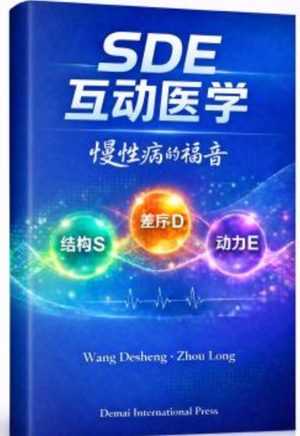
本书是一部建立在 SIO/SDE 哲学框架之上、以「发生学的治疗工程」呈现的慢性病治疗系统级重构。它不把慢性病当作「有待控制的数字」或「坏掉的器官」,而识别出一个共同的底层失败:过程启动了,却收不了尾——压力降不下档,代谢的峰值回不到基线,恢复相变薄,改善也无法沉积为稳定的能力。这解释了为什么许多患者变得「稳定却脆弱」:风险看似受控,生活却越来越窄、越来越依赖。
理论地基始于 SIO 本体论(主体—互动—客体),把健康定义为一个动态生成的互动整体。由 SIO 发展出 SDE:显露(S)作为承重能力,差异序列过程(D)作为可收尾的生理序列,纠缠之力(E)作为释放、恢复与沉积的引擎。(依正名,S 为显露 Show。)慢性病由此被重构为一种中段失败——自组织减弱、选择坍缩、转化停滞,回路合不上。三个旗舰病种被重建为统一模板:高血压是「压力之后降不下档」,压力滞留在循环释放里;血脂异常是「周转失败」,脂质离不开、暴露随时间累积;糖尿病是「回不到基线」,峰值易升而通路收不了尾——由薄的结构、断的序列、弱的燃料纠缠所驱动。
横贯这三者,治疗被重组为一套可复制的方法:场—粒—波训练——以场的支持降低噪声、打开恢复窗口;以粒子层的阈值功课(如呼吸)恢复切换与选择;以波态的节律运动训练收尾力与沉积——并与西医、传统医学、交互训练的功能角色重排相整合。全书以一条严格的终点判据收束——「返青」,它不由年龄或外表定义,而由三条硬证据定义:可靠的降档、更厚的恢复相、以及周与周之间的沉积与依赖递减。这不是生活方式建议,而是一份把「慢性病管理」转成「真正康复」、并在证据允许时给出结构化「退出」的严谨路线图。它是「健康与生命」群的总纲。
本书全文尚未上线。下面三篇选自王德生 2025 年前后的专著原稿《万物皆SIO:看身体、课堂、生活、科学的全新眼光》、《存在与发生》,可以先读。
壹身体是 SIO约 1.4 万字 · 2025-08-09在大多数人的日常认知里,身体只是一个客体(O):由器官、组织、细胞等部件组成,可以被切分、测量、修理。 贰三律医学的特征律入门约 9,500 字 · 原载「三二一智慧」2025-06-02本文系统性阐述了 WDS (王德生)意义三律中的第一律—— 特征律(Law ofIdentity)在三律医学体系中的理论基础、生理意义、病理机制与系统应用。 叁器官 SIO 三律病谱猜想约 1.5 万字 · 原载「华智慧泉」2025-05-28现代医学在器官病理研究中长期以“功能丧失”为主轴,将人体划分为分离的器官系统,并依据病原、组织学、影像与生化指标对疾病进行分类。SDE Interactive Medicine is a systems-level reconstruction of chronic disease treatment grounded in the SIO/SDE philosophical framework and expressed as a genesis-based therapeutic engineering. Rather than treating chronic illness as "numbers to control" or "organs that are broken," the book identifies a shared underlying failure: processes start but do not finish. Stress cannot downshift, metabolic peaks cannot return to baseline, recovery phases thin, and improvements fail to deposit into stable capacity. This explains why many patients become "stable yet fragile"-risk appears controlled, yet life grows narrower and more dependent.
The theoretical foundation begins with SIO ontology (Subject-Interaction-Object), which defines health as a dynamically generated interactive whole. From SIO, the book develops SDE: Show (S), whose stable structural state is load-bearing capacity, Difference-sequence process (D) as finishable physiological sequences, and Entanglement power (E) as the engine of release, recovery, and deposition. Chronic disease is reframed as a middle-stage failure-self-organization weakens, choice collapses, transformation stalls-and loops cannot close. Three flagship conditions are rebuilt as unified templates.
Hypertension is a failure to downshift after pressure, with stress lingering through circulatory release. Dyslipidemia is a turnover failure-lipids do not leave, exposure accumulates over time. Diabetes is a return-to-baseline failure-peaks rise easily while pathways cannot finish-driven by thin structure, broken sequences, and weakened fuel entanglement. Across all three, treatment is reorganized into a reproducible method: Field-Particle-Wave training-field support to reduce noise and open recovery windows; particle-level threshold work (such as breathing) to restore switching and choice; and wave-based rhythmic movement to train finishability and deposition-integrated with functional role reordering of Western medicine, traditional medicine, and interactive training.
The book concludes with a strict endpoint criterion, Return to Youth, defined not by age or appearance but by three hard evidences: reliable downshift, a thicker recovery phase, and week-to-week deposition with decreasing dependence. This is not lifestyle advice; it is a rigorous roadmap for turning chronic management into genuine rehabilitation-and, when evidence permits, a structured exit.