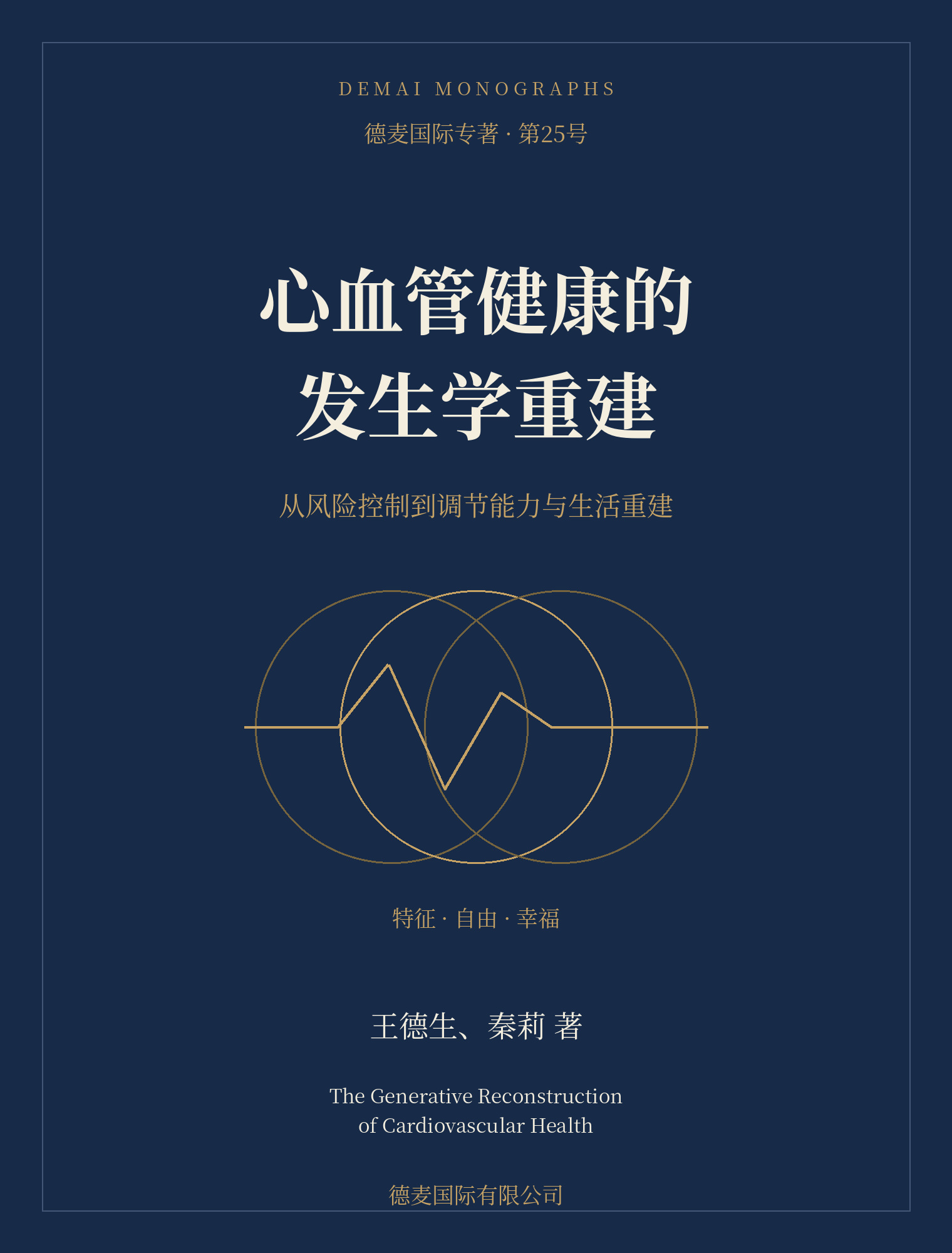
心血管健康的发生学重建 封面
健康与生命 · 德麦国际专著

心血管健康的发生学重建

The Generative Reconstruction of Cardiovascular Health
The Reversal of the Three Hypers
"三高"的逆转——从血管壁修复到生命节律重建的SIO视角。(The Generative Reconstruction of Cardiovascular Health,ISBN 978-1-970820-33-1)
内 容 简 介

本书为应对「三高」——高血压、高血脂、高血糖——探索一个新范式:把它们重思为「同一种慢性失调」的不同显现,而非三个孤立的病。它不聚焦于短期的数字控制,而主张:真正的心血管康复,取决于重建身体「循环、恢复、并随时间适应」的能力。

展 开 · 这本书在讲什么

全书内核是一个生成的、以过程为基础的框架,把慢性心血管失调看作「持续调节」的失败。高血糖反映一种「无法完成代谢回到基线」的序列失败;高血压反映一种「压力无法被释放并重新吸收进正常循环」;高血脂反映「物质无法被高效利用或清除」。三者合起来所指向的,不单是「过量」,而是「淤滞」——过程启动却收不了尾,压力累积却无法消解,能量在循环却未被转化。本书引入统一的 S/D/E 框架来描述并逆转这一状态:显露(S)指持久的生理能力,如血管弹性、肌肉耐力、代谢储备;动态序列(D)描述身体如何运行、切换并完成关键过程——血糖恢复、压力释放、脂肪利用;纠缠(E)代表让这些过程得以稳定、重复、改进的能量—恢复网络。心血管健康,本书主张,不由压制症状恢复,而由把这三个维度一起再生来恢复。

在此基础上,本书提出以「交互医学」作为慢性病逆转的中心逻辑:西医被重新定位为边界保护与风险遏制,传统医学作为地形支持与恢复促进;而真正的逆转,只有当患者主动参与迭代式的重建——在日常生活中学会启动、完成并恢复生理过程——才会发生。写给临床医生、研究者,以及一切正面对长期心血管风险的读者,本书既给出一张理论地图,也给出一套务实的操作系统。它的目标不只是靠控制换来更长的存活,而是恢复「代谢的自由」——那种能适应、能恢复、能不被慢性生理囚禁地生活的能力。

出 版 信 息 · PUBLICATION
作者 AuthorWang, Desheng; Qin, Li
出版方德麦国际有限公司 · Demai International Pte. Ltd.
ISBN978-1-970820-33-1(Bowker authorId 26927366)
检索Bowker / Bookwire · 可按 ISBN 9781970820331 查询
内 容 简 介 · BOOK DESCRIPTION

The Generative Reconstruction of Cardiovascular Health explores a new paradigm for addressing the Three Highs-hypertension, hyperlipidemia, and hyperglycemia-by rethinking them as manifestations of a single chronic dysfunction rather than three isolated conditions. Instead of focusing on short-term numerical control, this book argues that true cardiovascular recovery depends on rebuilding the body\'s capacity to circulate, recover, and adapt over time. At the core of the book is a generative, process-based framework that views chronic cardiovascular disorders as failures of ongoing regulation. High blood sugar reflects an inability to complete metabolic return-to-baseline sequences; high blood pressure reflects pressure that cannot be released and reabsorbed into normal circulation; high blood lipids reflect substances that cannot be efficiently utilized or cleared.

Together, these patterns indicate not excess alone, but stagnation-processes that start but cannot finish, stress that accumulates but cannot resolve, and energy that circulates without being transformed. The book introduces a unified S/D/E framework to describe and reverse this condition. Structure (S) refers to durable physiological capacity, such as vascular elasticity, muscle endurance, and metabolic reserves. Dynamic sequences (D) describe how the body runs, switches, and completes key processes-glucose recovery, pressure release, and fat utilization.

Entanglement (E) represents the energy-recovery network that enables these processes to stabilize, repeat, and improve. Cardiovascular health, the book contends, is not restored by suppressing symptoms, but by regenerating these three dimensions together. Building on this foundation, the book proposes interactive medicine as the central logic for chronic disease reversal. Western medicine is repositioned as boundary protection and risk containment; traditional medicine as terrain support and recovery facilitation.

Genuine reversal, however, occurs only when patients actively participate in iterative reconstruction-learning to initiate, complete, and recover physiological processes in daily life. Written for clinicians, researchers, and readers confronting long-term cardiovascular risk, The Generative Reconstruction of Cardiovascular Health offers both a theoretical map and a practical operating system. Its goal is not merely longer survival through control, but restored metabolic freedom-the ability to adapt, recover, and live without chronic physiological confinement.