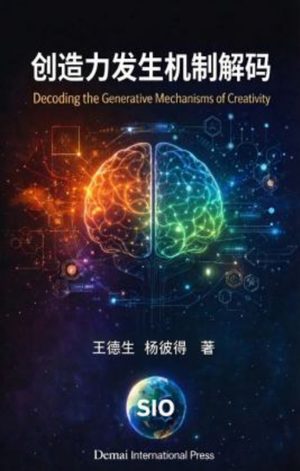
本书对创造力作一次严谨而原创的重思——把它看作一个有结构、可理解、可复制的过程,而非稀有的天赋、突降的灵感或少数人的特权。作者主张:创造力遵循可辨识的发生机制,这些机制可以被理解、练习,并稳定成真实的能力。全书内核是一切创造性涌现底层的「三律」:从混沌中生成特征,在纠缠的路径里经由选择的自由拓展可能,通过张力的转化与释放稳定新异。
这三条机制分别对应认知的组织、意志的选择、情感的转化,构成一个完整的循环——新结构、新观念、新意义经由它诞生。在此基础上,本书引入一套系统的「生成方法论」,以「基于成形的思考」取代「基于发现的思考」:目标被当作涌现的结构,路径是一连串分化的选择,约束则是激活创造过程的点火点。这些要素合起来,构成一个解释「创造力如何在真实处境(而非理想条件)中展开」的可操作框架。
本书进一步在哲学、心理学与科学之间架桥,阐明稀缺、冲突与张力如何成为创造性涌现的真实条件。借复杂性科学、认知动力学与系统思维,它论证秩序为何从混沌中生起、想象为何不是幻想而是对未来可能性的结构化预期。创造力由此被揭示为生成动力学的必然产物,而非一次统计上的反常。全书分四大维度展开——哲学与方法论地基、生成方法论、创造力的心理机制、科学想象与未来创造——写给哲学、教育、管理、科研、技术创新与个人成长领域的读者。它的核心主张既激进又务实:创造力不是有待等待或远远仰望之物,而是一个可被解码、激活、培育的过程。它是「创造力」群的地基之作。
本书全文尚未上线。下面三篇选自它的原稿《三律方法学:创造力发生机制解码》(王德生 著,2025),可以先读。
壹目标发生学的三大革命约 4.1 万字 · 原载「华智慧泉」2025-09-04自古以来,人们谈论“目标”时,总觉得那是一个再自然不过的概念:眼前有一件事,要去达成;远方有一个点,要去抵达。 贰路径依赖发生的三律解构和救赎约 3.6 万字 · 原载「SIO教育学」2025-09-03路径依赖(Path Dependence)是当代社会科学中一个广泛使用的概念。它常被用来解释经济、制度、教育、健康等领域的“历史锁定效应”:一条路径一旦被选择…… 叁创造力在匮乏中诞生约 2.6 万字 · 原载「创造力321」2025-07-17传统哲学、心理学乃至教育学对“创造力”的研究,长期受限于“主体中心论”的视角——将创造力视为主体个体内部的一种能力、禀赋或灵感的自然流露。Decoding the Generative Mechanisms of Creativity offers a rigorous and original rethinking of creativity as a structured, intelligible, and reproducible process rather than a rare gift, sudden inspiration, or privilege of a few. This book argues that creativity follows identifiable generative mechanisms that can be understood, practiced, and stabilized as real capability. At the core of the book is the Tri-Law underlying all creative emergence: the generation of features from chaos, the expansion of possibilities through freedom of choice within entangled paths, and the stabilization of novelty through the transformation and release of tension. These three mechanisms correspond to cognitive organization, volitional selection, and affective transformation, forming a complete cycle through which new structures, ideas, and meanings come into being.
Building on this foundation, the book introduces a systematic "generative methodology" that replaces discovery-based thinking with formation-based thinking. Goals are treated as emergent structures; paths are sequences of differentiating choices; constraints are ignition points that activate creative processes. Together, these elements form an operational framework that explains how creativity unfolds in real situations rather than idealized conditions. The book further bridges philosophy with psychology and science, showing how scarcity, conflict, and tension serve as the real conditions for creative emergence.
Drawing on complexity science, cognitive dynamics, and systems thinking, it demonstrates why order arises from chaos and why imagination is not fantasy but a structured anticipation of future possibilities. Creativity is thus revealed as a necessary outcome of generative dynamics rather than a statistical anomaly. Structured across four major dimensions-philosophical and methodological foundations, generative methodology, psychological mechanisms of creativity, and scientific imagination and future creation-the book speaks to readers in philosophy, education, management, scientific research, technological innovation, and personal development. Its central claim is both radical and practical: creativity is not something to be awaited or admired from afar, but a process that can be decoded, activated, and cultivated.
By shifting the focus from discovering what already exists to generating what has not yet taken form, Decoding the Generative Mechanisms of Creativity offers a new cognitive framework for innovation, learning, and future-oriented thinking in an increasingly complex world.