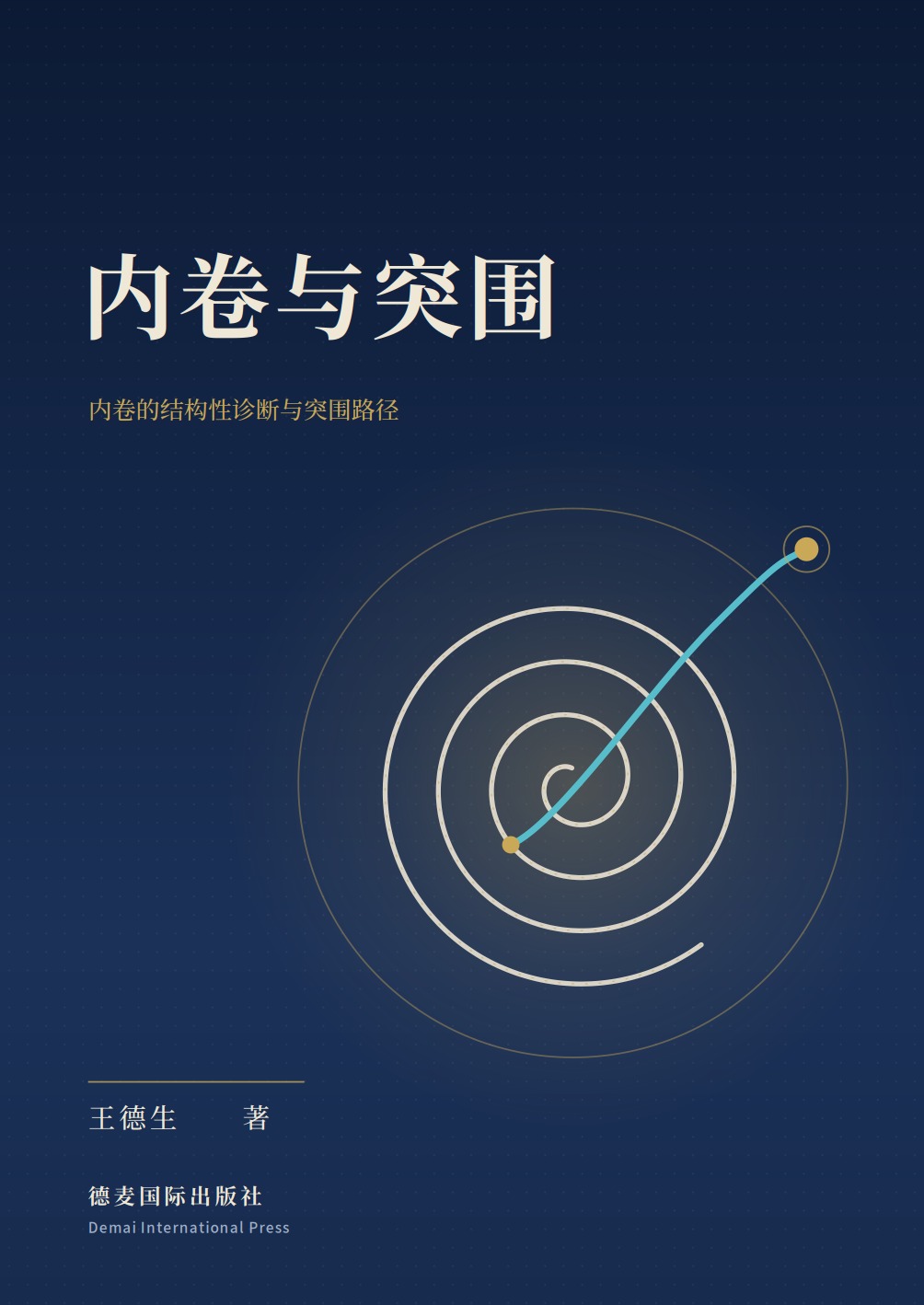
内卷与突围
内卷的结构性诊断与突围路径
孩子的书包越来越重,年轻人的简历越来越厚,公司的会越开越多,论文越发越快,真正让人眼前一亮的东西却越来越少。人们给这一切起了一个名字:内卷;出路也就顺理成章地被写成更努力、更精细、更快。本书拒绝这三句话。
它证明,边际效用递减的根因不在欲望疲劳,而在意义输入条件被价值持续削减:用价值购买意义,是内卷最深的根。从递减原理与膨胀律,到巴别塔倒塌定理与内卷的最严密定义;从教育、职场、科研,到通用人工智能与经济泡沫;最后落到出路:发生窗口的制度化,和 AEI。
七条承重命题
这本书在什么情况下算错
本书的核心是一套结构论证,不是一套已完成的实证研究。第 11 章用反证法立住递减原理:若找到一个系统,价值投入持续加码而意义体验的发生强度长期不降,主证明就要重审。第 41 章写了三组可反证命题:只改良指标而不开发生窗口的组织,会从粗糙的内卷进化为精致的内卷;发生窗口制度化能够逆转递减滞留;AI 对内卷的作用,取决于制度是否护持发生窗口。每一组都写明了反证办法,本书尚未检验,记为待检验。
这一版是怎样成书的
本书十个部分,原是 2025 年陆续写成、在本站逐篇发表的十篇长文。此次按德麦国际专著体例合编:第一篇《边际效用递减原理》原有的八编二十五章照原样作全书的第一至第八编;其余九篇拆为第九至十六编;统一编章,去掉单篇的编者按、摘要与关键词,篇间互引改为书内互见,删去一处重复(第二篇中复述递减原理证明的一章);旧稿「特征律」统一改称「创造律」。书中「SIO」「号位」等语汇属作者思想的 SIO 本体论阶段,现行口径见书末附录二。这一版又把全书逐章重写了一遍:论证、命题、公式与结论不动,长句拆短,每章以一个日常场景起笔,分节并收一句「带走的话」;反复重讲的基础概念只在首次出现处讲透,其余处指回原章。原稿未注出处的统计数字、机构说法与新闻事件保留原话,句后标「〔待核〕」,读者引用前请自行查证。排版逐页检查:中西文间距、章末孤页、节题落底、目录页码与页眉都已校过。原十篇网页仍保留:《内卷与突围》分篇网页。
作者简介
王德生,SDE(显露 Show · 差异序列 Difference · 特征纠缠 Entanglement)本体论的创立者,德麦国际(Demai International Pte. Ltd.,新加坡)首席执行官。中国科学院计算数学博士,曾在英国斯旺西大学与新加坡南洋理工大学工作。他的思想走过四站:三视角、321 智慧、SIO 本体论、SDE 本体论;本书各部分写于 SIO 本体论一站。
全书结构
- 前置 作者介绍 · 前言 · 导读 · 导论
- 第一编 概念与本体:把「效用」改写为意义体验(第 1—3 章)
- 第二编 意义发生学(第 4—6 章)
- 第三编 价值稳定学(第 7—9 章)
- 第四编 主证明:边际效用递减的发生学证明(第 10—12 章)
- 第五编 内卷发生学(第 13—15 章)
- 第六编 跨学科基石(一):经济学重写(第 16—17 章)
- 第七编 跨学科基石(二):心理学与健康学重写(第 18—20 章)
- 第八编 跨学科基石(三):管理学、教育学与 AI 文明学(第 21—26 章)
- 第九编 膨胀律与巴别塔倒塌定理(第 27—34 章)
- 第十编 定义与对话:内卷的最严密定义及其解释边界(第 35—41 章)
- 第十一编 教育(第 42—46 章)
- 第十二编 职场(第 47—51 章)
- 第十三编 科研(第 52—57 章)
- 第十四编 AGI 为何解决不了具体问题(第 58—63 章)
- 第十五编 泡沫:从巨型教育泡沫到全球经济泡沫(第 64—69 章)
- 第十六编 AEI:对抗内卷的出路(第 70—75 章)
- 后置 结语 · 参考书目 131 种 · 附录三件 · 后记
Book Description
Involution has become one of the defining conditions of our time. People work harder, compete more intensely, optimize endlessly-yet genuine renewal, freedom, and creative breakthrough seem increasingly rare. Involution and the Way Out offers a rigorous structural redefinition of this phenomenon and proposes a practical path beyond it. Rather than treating involution as a psychological mood, moral failure, or simple market competition, Wang Desheng defines it as a structural state: the long-term lock-in of systems where marginal value continues to increase while meaningful generation steadily declines.
In such a state, effort remains high but generative capacity weakens; expansion replaces innovation; proof replaces creation; stability replaces renewal. The result is what the book calls a "diminishing-value age," in which development persists but regeneration fades. Drawing on the SDE generative framework (Show-Difference-Entanglement), the book demonstrates why involution is not accidental but systemic. When stability becomes permanent and difference is confined within existing structures, the conditions required for genuine emergence-uncertainty, tension, and living entanglement-are gradually reduced.
Marginal returns decline, and systems become trapped in self-reinforcing cycles of escalation. The way out is not withdrawal, nor blind acceleration. It is the reconstruction of generative capacity. The book introduces a clear decision model-structural exit, strategic stillness, or renewed 0-to-1 generation-based on energy states within complex systems.
It further develops a "generative window engineering" approach and outlines how AI, if reoriented toward AEI (Augmented Emergent Intelligence), can serve as a guardian of renewal rather than an amplifier of involution. Bridging philosophy, economics, education, organizational theory, and AI, this work provides both theoretical depth and practical tools. It is not merely a critique of involution-it is a blueprint for rebuilding meaning in an age of diminishing value.