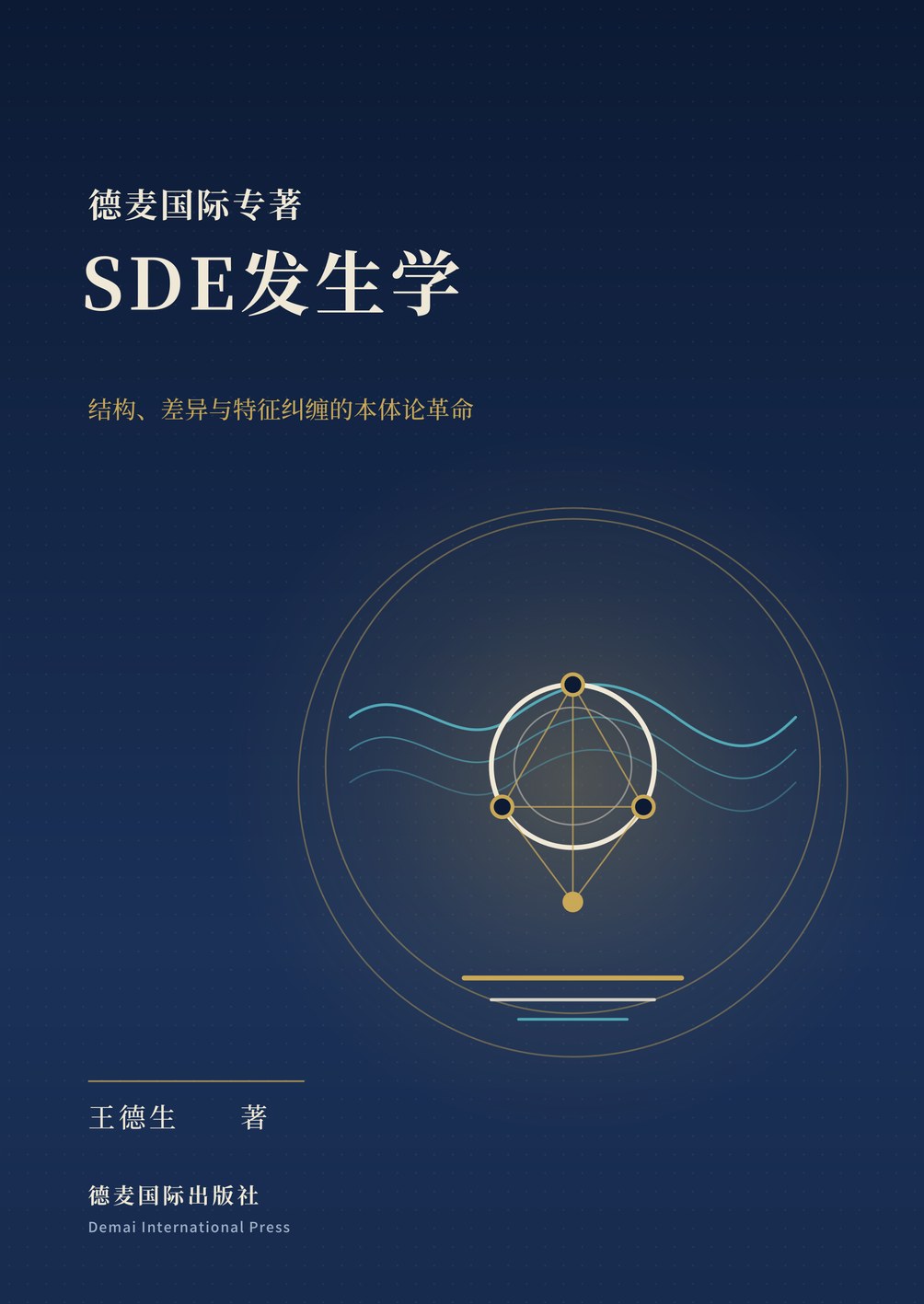
本书是一场关于「知识、能力与创新如何被理解、又如何被生产」的本体论革命。现代文明拥有了惊人的解释力——模型繁殖、指标精细、标准扩张——可真正的成长却越来越脆弱:学习坍缩成机械累积,创造沦为偶然,组织硬化为流程,健康变成无休止的补偿。病根不在信息短缺,而在一套错误的本体论:把稳定当作现实与知识的起点,而把那个真正决定成败的「中段」——稳定的特征究竟如何被生成——结构性地忽略了。
本书用一套可复制的发生理论,替换以结果为中心的「发现」叙事,立起一台严格的三维存在引擎:S、D、E。(须说明:依本学派 2026 年正名,S 是显露 Show——存在得以被识别、被复制、被界定的可行显影态,而非「主体」。)在这个框架里,基本单位不是孤立的主体或客体,而是一个可被整体分析、诊断、重写的 SIO 结构。D 不是一组静止的差异,而是差异之流——回合、阈值、漂移与分岔的序列,现实借之推进、结构被迫改变。E 是特征纠缠:一张动态之网,特征通过构建、稳定、触发、释放的循环成为可行动的模块,正是这台隐藏的引擎,让成长得以持续而非损耗。
本书把这些原理化为一门可操作的生成手艺:它把六步迭代环(猜想—执行—评估—反馈—修正—迭代)重构为由纠缠动力驱动的内部控制系统,并给出分阶段的运行条件(涌现→发展→成形),防止创新退化为僵化、噪声或漂移。成果是一套不止于解释、而且可训练、可复制、可跨域迁移的框架。书末以金点子创新、欲望的形成、抑郁作为纠缠—能量的退化、无为作为成熟稳态的运行、慢性病的交互医学等应用,展示其跨域穿透力。这是本体论核心群的引擎室。
SDE Genealogics presents an ontological revolution in how knowledge, capability, and innovation are understood and produced. Modern civilization has achieved extraordinary explanatory power-models proliferate, metrics refine, and standards expand-yet genuine growth has become increasingly fragile. Learning often collapses into mechanical accumulation, creativity becomes an accident, organizations harden into procedure, and health turns into endless compensation. The deeper cause is not a shortage of information, but a mistaken ontology: stability is treated as the starting point of reality and knowledge, while the decisive "middle"-how stable features are generated-remains structurally neglected.
This book rewrites that foundation by replacing result-centered "discovery" narratives with a reproducible theory of genesis. It introduces a strict tri-dimensional engine of existence: S, D, and E. Crucially, S does not mean "subject." S means SIO Structure-a workable structural state in which existence becomes identifiable, reproducible, and bounded. In this framework, the basic unit is not an isolated subject or object, but an integrated SIO structure (Subject-Interaction-Object) that can be analyzed, diagnosed, and rewritten as a whole.
D is not a static set of differences, but a delta-flow: sequences of turns, thresholds, drifts, and bifurcations through which reality advances and structures are forced to change. E is Feature Entanglement: a dynamic network in which features become actionable modules through cycles of building, stabilizing, triggering, and releasing-providing the hidden "engine" that makes growth sustainable rather than consumptive. SDE Genealogics turns these principles into a practical generative craft. It reconceives iteration (the six-step loop of conjecture, execution, evaluation, feedback, correction, and iteration) as an internal control system powered by entanglement dynamics, and it formulates stage-based operating conditions (emergence ¿ development ¿ formation) to prevent innovation from degenerating into rigidity, noise, or drift.
The result is a framework that is not merely interpretive, but trainable, repeatable, and transferable across domains. Beyond theory, the book demonstrates SDE\'s cross-domain power through applications in idea innovation, desire formation, depression as entanglement-energy degradation, "wu-wei" as mature stable-domain operation, and interactive medicine for chronic conditions. SDE Genealogics offers a new public language for explaining-and designing-how structures grow, how breakthroughs become reproducible, and how meaning becomes structurally durable.